

That weird feeling in your room? It might be your curtains.
Not the rug. Not the paint color. Not the artwork you swore would tie it all together.
Linen curtains changed my space more than any Pinterest board or throw pillow ever could. And before you roll your eyes, hear me out. I didn’t believe it either—until I replaced the lifeless synthetic panels I’d bought on sale with actual natural linen curtains. That’s when the room finally started breathing.
There’s a reason your room feels “off” no matter how many candles you light or plants you bring in. If your curtains are fighting the light, clashing with your textures, or just… hanging there like cardboard, your space won’t feel right. But linen? Linen does something different.
Let’s talk about what that is.
Your current curtains might be ruining the vibe
Living room curtains and bedroom curtains do more than just cover windows. They’re part of the room’s energy. And yes, that sounds woo-woo. But it’s also just physics and materials.
If you’re using:
- Stiff polyester panels that reflect light weirdly
- Glossy “faux linen” that looks plastic in daylight
- Patterned drapes that scream louder than the furniture
…then the room feels disconnected. It looks overdone or cold. Or worse—it looks like a hotel.
Even the smallest details—like the stitching, the drape, the way they move—can throw off the feeling of a space.
So here’s what linen curtains do differently.
Linen curtains filter light, not block it
Here’s the core of it: most curtains either block light completely or do nothing at all. Linen hits the sweet spot.
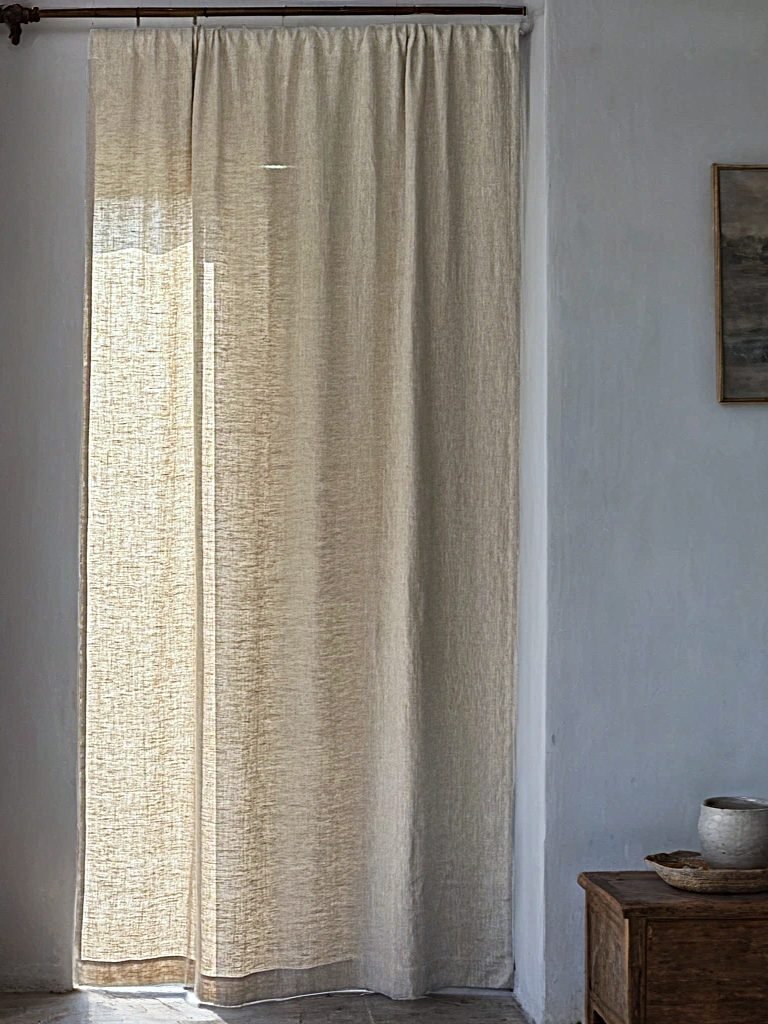
Natural linen curtains soften and diffuse daylight instead of cutting it off. You still get the sun, but not the harsh glare or overexposed Instagram look.
This is especially true if you’re using:
- Linen curtain panels in light beige or grey linen curtains
- Beige grey curtains with an open weave that catches light beautifully
- Or a classic ticking stripe curtain that adds subtle rhythm to the space
You don’t feel like you’re sitting in direct sunlight, but you’re not living in a cave either. There’s a reason the phrase “natural light through curtains” gets searched so much—it’s what people actually want.
Most curtains feel fake. Linen doesn’t.
You know that “slippery” feeling some window drapes have? That’s polyester. It reflects light in unnatural ways, makes strange swishing sounds, and often looks wrinkled in all the wrong places.
Now contrast that with rough linen curtains. The texture is honest. The wrinkles are meant to be there. They look alive, like part of the room, not pasted on top of it.
Why does this matter?
Because texture is what makes a room feel warm and human. Flat materials flatten a space. Natural ones bring it to life.
Striped linen and ticking patterns create calm movement
Ever walked into a room and felt like something was too… still? Not peaceful. Just stiff.
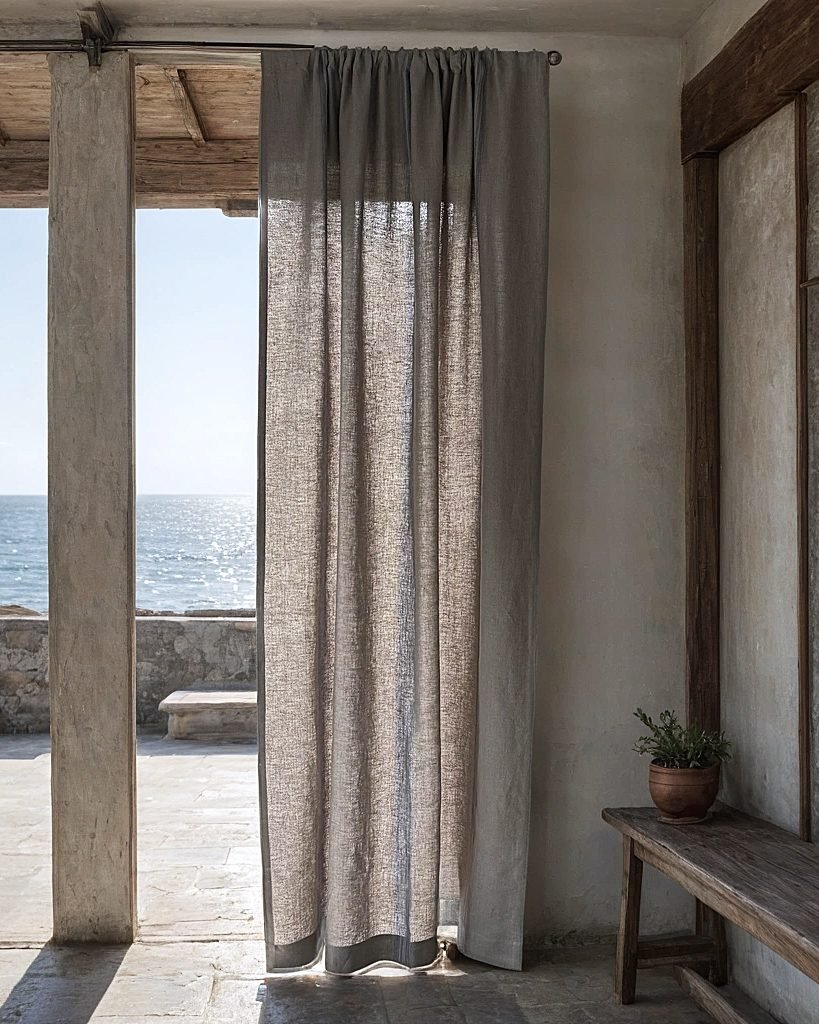
That’s where striped linen curtains and ticking stripe curtains work magic.
They add:
- Vertical rhythm that elongates windows and balances heavy furniture
- Visual softness without needing florals or loud prints
- Just enough pattern to break up monotony
And in farmhouse window treatments or coastal farmhouse linen curtains, those subtle stripes feel grounded, not trendy. It’s timeless calm, not seasonal hype.
Why synthetic blackout curtains feel emotionally heavy
Not everything needs to be pitch black to feel peaceful. Especially not in shared spaces like the living room or kitchen. Yet many homes are full of heavy blackout panels that turn a sunny room into a basement.
Here’s the issue: when you shut out all light, your space disconnects from the outdoors. It starts feeling artificial.
With heavy linen curtains, you get:
- Light blocking when you need it
- Texture that reflects nature, not plastic
- Breathability in both look and feel
And you can layer them—use linen curtain panels with a sheer linen layer underneath for more control.
No synthetic drape will give you that kind of flexibility. Or that feeling of ease when you walk into the room.
Your color choices matter more than you think
Let’s talk tones. If you’ve got walls in soft neutrals, adding bright white polyester curtains often creates harsh contrast.
Natural linen curtains come in tones that actually make sense with real-life interiors:
- Light beige curtains that soften walls, not fight them
- Grey linen curtains that give balance to wood or stone elements
- Beige grey curtains that adapt across seasons and lighting
And yes, striped linen curtains still work in minimalist spaces. They add softness without clutter.
Curtains aren’t just about color—they’re about how that color behaves in natural light. And linen wins every time.
The small details that change how a room feels
Here’s what most people miss: how curtains move matters.
Linen isn’t stiff. It sways when you walk by. It catches air. It shifts with the day.
That movement makes a room feel alive. Not staged. Not frozen. And that’s a huge part of why curtain living room ideas that feature linen feel calmer, more grounded, more… real.
If you’re styling with:
- Drapery panels in neutral tones
- Natural linen curtains that reach the floor
- Soft, unlined panels that move freely
…you’re already creating a space people want to be in.
Why linen is perfect for both new homes and fixer-uppers
You don’t have to live in a renovated farmhouse to use farmhouse window treatments. And you don’t need ocean views to pull off coastal farmhouse linen curtains.
Linen works because it’s honest. It doesn’t pretend to be fancier than it is. That makes it perfect for:
- Apartments that need warmth and texture
- Bedrooms that feel too sterile
- Living rooms with too much hard surface
- Kitchens with sharp morning light
And IMO, heavy linen curtains are one of the easiest upgrades for renters or homeowners who want big visual change without committing to a remodel.
The linen mindset: imperfect, layered, and calm
Part of what linen brings to a room isn’t just about material—it’s about mindset.
Unlike crisp cotton or stiff synthetics, linen is okay with being imperfect. And that’s a refreshing shift. A little wrinkle here, a relaxed fold there—it feels intentional, not lazy.
That’s why you’ll find bedroom linen curtains ideas centered around relaxation, softness, and slower mornings.
And it’s why window drapes in linen always photograph better in natural light—they don’t hide it. They shape it.
So… what makes linen different?
Let’s recap what natural linen curtains do that most curtains don’t:
- They soften daylight instead of blocking it
- They move naturally, making a space feel alive
- They bring in texture, not shine or stiffness
- They age well, getting softer over time
- They suit every room, from modern to rustic
- They play nicely with neutrals, wood, stone, and light
Most importantly, they make your home feel like a place to be, not just a place to decorate.
Ready to stop settling for the “off” feeling?
Here’s your fix-it plan:
- Choose linen over synthetic. The real deal, not “linen-look” plastic.
- Pick your tone: beige, grey, or striped linen curtains—they all work.
- Decide on the room: bedroom, living room, kitchen—it doesn’t matter. Linen fits.
- Hang them long, let them move, let them breathe.
Your space will finally feel like itself. And so will you.
Your Unignorable CTA:
Stop fighting your space. Let it feel easy. Your 4-step refresh:
- Pick the right linen curtain.
- Choose your tone: soft beige or bold stripe?
- Hang it floor-length and loose.
- Watch your room finally click.

